
Utah State Criminal Appeals ‐ Making a case for reversal in your darkest hour
Considering a criminal appeal in a Utah appellate court? Trial attorneys may not be enough. Appellate law is a unique legal arena, requiring a specialized approach. At Lotus Appellate Law, we focus exclusively on navigating the complexities of Utah criminal appeals with precision, skill, and a commitment to achieving justice for you.
Justice may still be within reach — Contact Lotus Appellate Law to discuss your appeal.
Understanding the Criminal Appeals process
Navigating the Complex Appellate Process in Utah
The criminal appellate process in Utah is complex, with distinct rules and procedures that differ significantly from trial court rules. Review our complete Utah Rules of Appellate Procedure filing deadline timeline to understand the deadlines and procedural requirements governing your criminal appeal, or reach out to us today to discuss how Lotus Appellate Law can help you navigate the process.

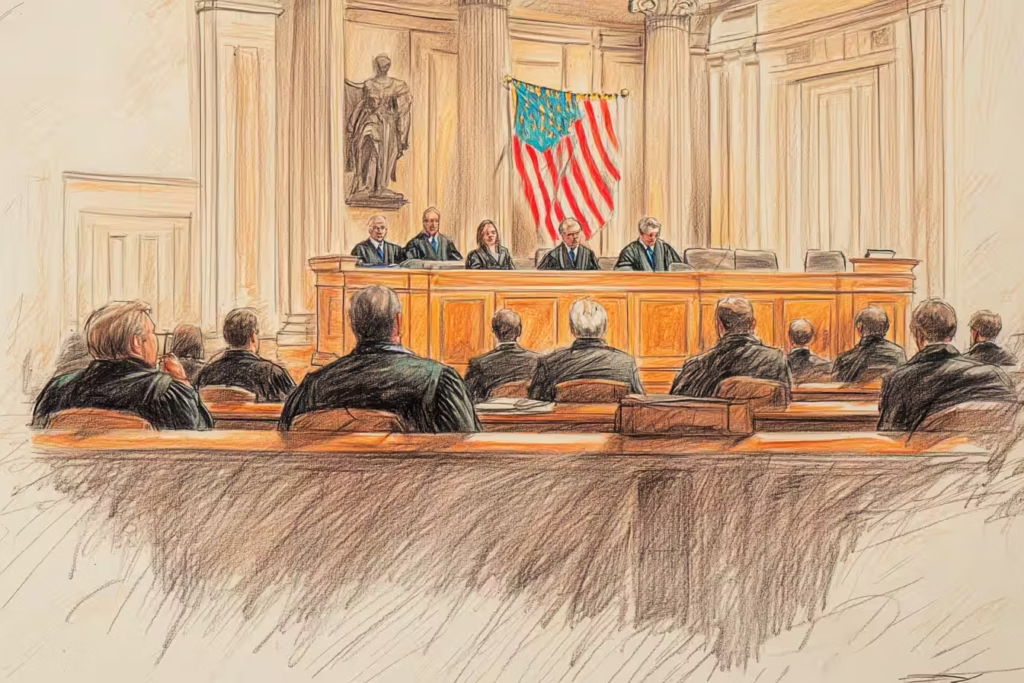
How do I get my Conviction reversed?
Getting a criminal conviction reversed is no easy task. Appeals are costly, and up to 90+% of criminal appeals in Utah are not ultimately reversed. But in serious cases where your freedom and good name are on the line, it may be worth it to try.
After a trial, many families have very little fight left in them. To stay in the game, you will need an appellate attorney who has the expertise to guide your team, to take the lead, and to push that rock up that hill for you.
We can help. In the appellate arena, trial expertise is not enough. Our attorneys are some of the most experienced criminal appellate attorneys in the state. And you need experience. Appellate law is a unique legal arena requiring a special understanding of all of the appellate procedural rules–as well as criminal law. At Lotus Appellate Law, we focus on navigating the complexities of Utah criminal appeals with precision, empathy, and a commitment to justice.
Why experience matters
The appellate process in Utah is intricate, involving different rules and procedures than those used in district courts. At Lotus Appellate Law, we understand that appealing a case can be exhausting and overwhelming, and the likelihood of success for your appeal often hinges on expertise in the nuances of appellate procedure and spotting issues that are reversible. It is crucial to work with a firm that specializes in appeals and understands the process forward and backward.
Choosing Lotus Appellate Law means placing your trust in a team that dedicates its practice exclusively to appellate cases. Our focus allows us to stay up-to-date on the latest developments in Utah appellate and criminal law. We have the insight to identify potential issues and leverage those to your advantage, increasing your chances of a favorable outcome.
Keep in mind that an appellate court will not review the record in your case. Appellate records frequently span anywhere from 900 to 2,000 pages. These records are simply too long for appellate judges to read front to back. So reading the record and identifying areas for judicial review is your appellate attorney’s job. Without your appellate attorney’s keen insight into what issues are even possible to raise before the appellate court and how to raise them persuasively, your appeal might not stand a chance. You need someone you can trust to do the heavy lifting and deep thinking–making it easy for the judges to rule in your favor.
Understanding the complexity of appeals
Okay, so what exactly is an appeal?
It is important to understand that an appeal is not a redo of your trial; it’s an entirely different stage of litigation that focuses on reviewing legal errors made in the trial court. Unlike district courts, which assess evidence and witness credibility, appellate courts review the trial court’s judgments for mistakes in its application of the law as it stands to the facts of the case.
This shift in focus means the rules of engagement change significantly. For example, on appeal you cannot bring new evidence to light, and you cannot make arguments you failed to make in the district court. As well, an appellate court may affirm for any reason apparent on the record, including if a party fails to attack every rationale for a district court’s holding.
In Utah, the state appellate courts have their own set of procedural rules that differ from the district courts. The requirements for filing a notice of appeal, preparing briefs, and presenting oral arguments are governed by these unique rules. The Utah Court of Appeals and the Utah Supreme Court have strict timelines and technical requirements that must be met to avoid having your appeal dismissed. A failure to meet deadlines can be a jurisdictional bar to filing your appeal.

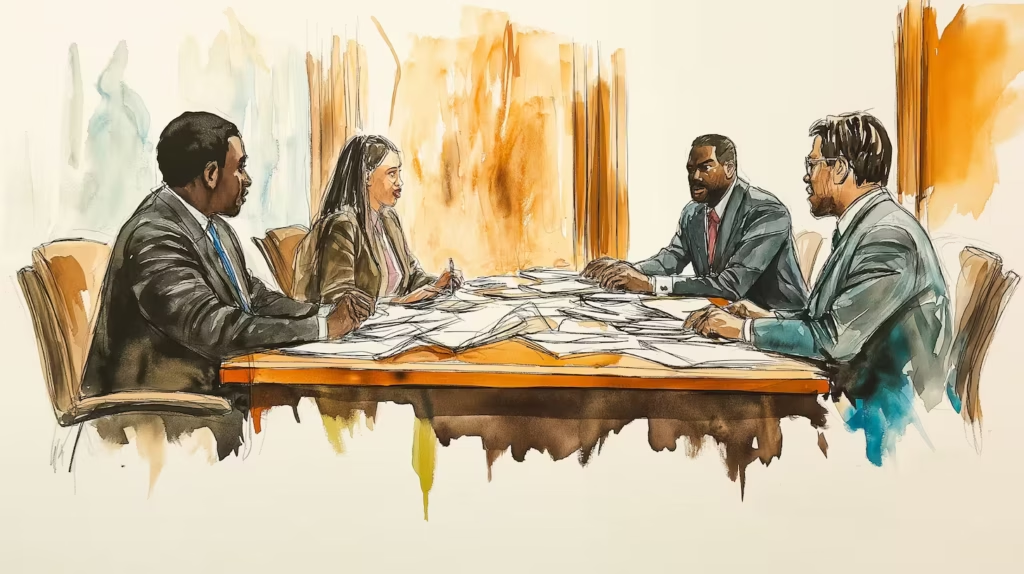
Why Appellate Attorneys are Necessary to Appeals
The role of an appellate attorney is vastly different from that of a trial attorney. Appellate attorneys should be expert legal researchers as well as expert legal writers. They must possess a deep knowledge of appellate procedure and the underlying substantive law of the case, be skilled in persuasive legal writing, and have the wisdom to craft 50-60 page legal documents without exhausting the judges who read them.
Identifying and arguing these points effectively requires an appellate attorney who knows what to look for and how to present these errors persuasively in briefs and during oral arguments. Appellate clerkships train appellate attorneys to think like a judge, write like a judge, and reason like a judge. There is no substitute for that experience.
Given the complexity and highly specialized–and high stress, emotionally exhausting–nature of criminal appeals, it is crucial to have experience by your side. Our attorneys have filed, mooted, or helped draft literally hundreds of briefs in the Utah appellate courts.
Lotus Appellate Law’s attorneys focus exclusively on appellate work so there is no guessing involved. We know the procedural traps that can derail an appeal–for example, inadequate briefing, arguing the wrong standard of review, or leaving alternative reasons for affirmance on the table–so we know how to avoid them. We can navigate the process for you so you don’t have to.
Can I Appeal My Case
Most likely. When you appeal your case, the Utah Court of Appeals agrees to consider the trial court’s proceedings for legal errors that may have impacted the outcome of your case. It’s important to understand that not every unfavorable ruling qualifies as a strong appellate issue.
In a strong appellate issue, there must be a basis for arguing that a legal mistake occurred at trial. But while legal errors abound at trial, reversible errors are more difficult to find. Showing that an error occurred simply isn’t enough. You also have to show that the error made a difference. In the law, we call this “harm” or “prejudice.”
In most cases, the burden to show harm is on the defendant. In other words, the defendant must show that absent that error, there is a reasonable likelihood of a different result. But in some instances, the burden of showing of harm is actually reversed. For example, if the issue is a preserved constitutional issue, then the State has the burden of showing that the error did not prejudice the defendant.
Appellate Standards of Review
Appellate courts review each issue under a different “standard of review.” Standards of review assign a certain amount of deference to each issue. Was the issue presented to the district court? Did the court have a chance to rule on it? If so, the standard of review will either be correctness or abuse of discretion. If the issue was not presented to the district court, then the court of appeals may still consider it. But it will only consider those issues under special standards of review that require special showings.

Abuse of Discretion
Certain issues–like sentencing issues and evidentiary issues–are reviewed for an abuse of discretion. When an appellate court reviews an issue for an abuse of discretion, it will only reverse the conviction if the court concludes that no other district court judge would have made the same decision. This is a highly deferential standard of review–which means that in the majority of cases, the appellate court will defer to the trial court’s judgment.
Correctness
Preserved legal issues are reviewed for correctness. This means that no matter what the district court ruled, the court of appeals has the chance to correct it. Sometimes legal holdings can be embedded in evidentiary issues, which are usually reviewed for abuse of discretion. But if you can argue that what the court has is an embedded legal issue–and not an evidentiary call–then you can get the court to review the issue under the less deferential “correctness” standard.

Unpreserved issues can sometimes be reversible in criminal appeals
In civil appeals, you may only raise preserved issues or issues that are reversible under plain error review. But in criminal appeals, you may sometimes raise an unpreserved issue if you can properly identify an exception to the preservation rule.
Plain Error
A claim of plain error points the finger at the trial court, saying “hey, you should have known better. This mistake should have been obvious.”
When you raise an issue under plain error, you have to show three things: First, that there was an error; second, that the error should have been obvious to the trial court; and third, that absent the error, there is a reasonable likelihood of a different result. Under this standard of review, you have to show that the error should have been so obvious to the trial court and that it impacted the outcome with such great force that the appellate court should order a new trial.
This standard of review is one of the most difficult to show, because of the “obviousness” showing you must make.
Ineffective Assistance of Counsel: the Sixth Amendment’s protections
The Sixth Amendment to the United States Constitution guarantees the effective assistance of trial counsel in criminal cases–even when you cannot afford an attorney. On appeal, when you raise an issue under ineffective assistance, you are claiming that your trial counsel’s representation fell below certain standards.
When you claim ineffective assistance of counsel, you must show three things: First, that trial counsel’s performance fell below an objectively reasonable standard, and second, that absent the error, there is a reasonable likelihood of a different result. These errors don’t have to be obvious, but they do have to surpass a significant hurdle: if there was any way that objectively reasonable trial counsel could have chosen to overlook the alleged “error,” then the appellate court won’t second-guess trial counsel’s alleged “strategy.”
This standard of review is also difficult to surpass, because the appellate court will often credit trial counsel’s erroneous conduct with trial strategy.
At times, the evidence of ineffective assistance of counsel is not on the record. So how can you show evidence that your trial counsel did you wrong if you can’t admit extra-record evidence on appeal? The Utah Rules of Appellate Procedure allow a defendant to file a motion concurrently with the opening brief admitting evidence of ineffective assistance of counsel. If this motion is granted, then the appellate court will remand the case back to the trial court to hold an evidentiary hearing where trial counsel will have the opportunity to testify. After this evidentiary hearing, the case is transferred back to the court of appeals for a final determination.
What will happen to my case if I win?
The exact remedy available to the appellate court is always important to keep in mind when you raise any given issue. That is because certain issues will only get you entry of a lesser included offense, while other issues will get you a complete do-over. Likewise, some errors will have an impact on only one charge, while other errors will have a pervasive impact on the whole trial.

Is there any way to get a reversal without being retried? Yes, but, of course, that is a very tall order. In order to get a reversal without a retrial, you must show that the State failed to produce enough evidence to support a guilty verdict the first time around. When the appellate court looks at the evidence under this microscope, it will only reverse if the available inferences from evidence admitted do not support a conviction. In other words, if the jury could have inferred guilt based upon the testimony or other evidence, the court will not reverse. These types of issues are called “sufficiency” issues, and they are the holy grail of appellate issues.
Let us help you
Given these complexities, it’s crucial to consult with an experienced appellate attorney early in the process to evaluate whether your case is a good candidate for appeal. At Lotus Appellate Law, we thoroughly review the appellate record, identify all available issues, and which issues have the greatest likelihood of success, ensuring you have a realistic understanding of your options.
If you believe an error occurred in your trial and are considering an appeal, we would love to discuss your case with you and explore your options.
What Our Clients Are Saying: “Trusted Expertise in Appellate Law”
Compare Us
Should you Hire an Appellate Law Firm?
Frequently Asked Questions
Utah Appellate Process