
Utah Criminal Appeals: Fighting for Reversal When It Matters Most
A criminal conviction is not always the final word. When the trial court made a legal error — in admitting evidence, in instructing the jury, in calculating a sentence — the Utah Court of Appeals has the authority to reverse it. But the window to act is 30 days, and the record that determines the outcome is built at trial, not after.
Justice may still be within reach — Contact Lotus Appellate Law to discuss your case.
Understanding the Criminal Appeals process
Navigating the Complex Appellate Process in UtahThe criminal appellate process in Utah is complex, with distinct rules and procedures that differ significantly from trial court rules. Review our complete Utah Rules of Appellate Procedure filing deadline timeline to understand the deadlines and procedural requirements governing your criminal appeal, or reach out to us today to discuss how Lotus Appellate Law can help you navigate the process.
What a Utah Criminal Appeal Actually Is — and What It Is Not
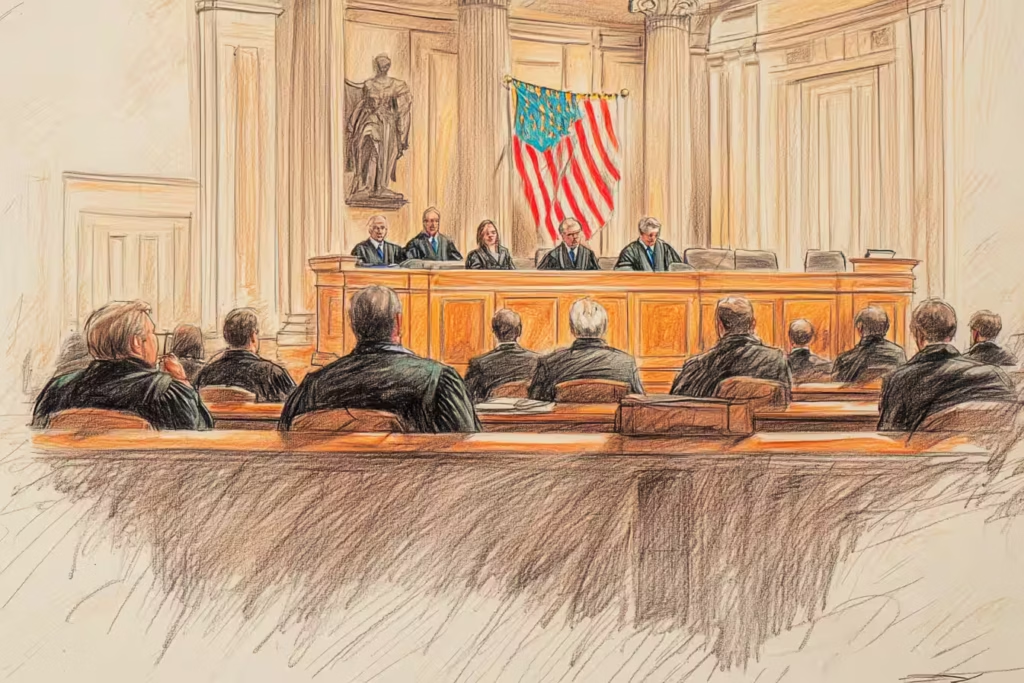
A criminal appeal is not a second trial. No new witnesses testify. No new evidence is introduced. The Utah Court of Appeals reviews the written record of what happened in the district court — the transcript, the exhibits, the orders — and asks a single question: did the trial court make a legal error that affected the outcome?
That constraint is also the appeal’s defining feature. The appellate court reviews each issue under a standard of review — de novo for pure legal questions and constitutional violations, abuse of discretion for evidentiary and sentencing rulings, plain error for unpreserved issues. The standard matters as much as the underlying argument, because it determines how much deference the court gives to the trial court’s decision and how strong the case for reversal needs to be.
Lotus Appellate Law is a boutique Utah appellate firm that handles criminal appeals exclusively at the appellate level — before the Utah Court of Appeals, the Utah Supreme Court, and the Tenth Circuit. This guide covers the full landscape: how the process works, what grounds exist for reversal, what the deadlines are, and what the realistic path to a different outcome looks like.

How Utah Criminal Appeals Work
The 30-Day Deadline
A notice of appeal must be filed within 30 days after entry of the judgment of conviction and sentence, under URAP Rule 4. This deadline is jurisdictional — missing it by even one day destroys appellate jurisdiction, with no extension for attorney error or excusable neglect. The appeal begins with this filing, which triggers transcript designation, record compilation, and the briefing schedule that follows.
See How Utah Criminal Appeals Work for the complete step-by-step process, and Lotus’s URCrP filing deadlines reference for the full procedural timeline.
Where Most Criminal Appeals Go
Most Utah criminal appeals are decided by the Utah Court of Appeals. The significant exception is capital felony cases and first-degree felony convictions — those go directly to the Utah Supreme Court under Utah Code § 78A-3-102. For cases at the Court of Appeals, a further appeal to the Supreme Court by petition for certiorari is discretionary — granted only when the case presents a significant legal question under URAP Rule 46.
What the Appeal Reviews — and What It Cannot
The appellate court is limited to the trial record. It cannot hear new testimony or consider evidence that was not part of the original proceedings. Arguments not raised in the trial court are generally waived — subject only to the narrow exceptions of plain error (obvious and harmful) and exceptional circumstances (genuine procedural breakdown). The one mechanism for introducing evidence outside the record on direct appeal is the URAP Rule 23B motion, available for ineffective assistance of counsel claims only.
What Gets Criminal Convictions Reversed in Utah
Issue Preservation: The Foundation of Every Criminal Appeal
The most important concept in Utah criminal appellate practice is the preservation rule: issues not raised in the trial court generally cannot be raised on appeal. Preservation requires a specific, timely objection on the correct legal ground — a general “I object” does not preserve a specific constitutional argument. And the invited error doctrine bars a party from appealing an error it induced at trial.
See Issue Preservation in Utah Criminal Appeals for the complete framework, including plain error, exceptional circumstances, and the interaction with IAC claims.
Ineffective Assistance of Counsel
A conviction based on constitutionally inadequate trial representation can be reversed. Under Strickland v. Washington, 466 U.S. 668 (1984), IAC requires both deficient performance — below what a reasonably competent attorney would have done — and prejudice — a reasonable probability the outcome would have been different. Most IAC claims require evidence outside the trial record, which is developed through a URAP Rule 23B remand filed concurrently with the opening brief.
See Ineffective Assistance of Counsel Appeals in Utah.
Sufficiency of the Evidence
When the prosecution failed to produce legally adequate evidence of guilt — not just thin evidence, but legally insufficient evidence — a successful sufficiency challenge produces acquittal rather than retrial. Double jeopardy bars any further prosecution. See Sufficiency of the Evidence in Utah Criminal Appeals.
Evidentiary Errors
Improper admission or exclusion of evidence under Rules 403, 404(b), or 802, combined with the Confrontation Clause framework from Crawford v. Washington, generates some of the most commonly litigated claims in Utah criminal appeals. The standard is abuse of discretion for evidentiary rulings generally, de novo for constitutional violations. See Evidentiary Errors in Utah Criminal Appeals.
Prosecutorial Misconduct
Improper closing argument, vouching for witnesses, misstating evidence, and shifting the burden of proof are among the most common forms of prosecutorial misconduct raised on appeal. A successful claim requires showing both that the conduct was improper and that it had a reasonable likelihood of affecting the verdict. See Prosecutorial Misconduct as Grounds for Reversal in Utah.
Brady Violations
Brady v. Maryland, 373 U.S. 83 (1963), requires prosecutors to disclose evidence favorable to the defendant when that evidence is material to guilt or punishment. Suppression of exculpatory evidence — including undisclosed cooperation agreements with witnesses under Giglio — can reverse a conviction when the suppressed evidence creates a reasonable probability of a different result. See Brady Violations in Utah Criminal Appeals.
Constitutional Violations
Fourth, Fifth, and Sixth Amendment violations drive a significant portion of successful criminal appeals. Unlawful searches and seizures produce suppression arguments reviewed de novo. Miranda violations and coerced confessions raise Fifth Amendment claims that shift the harmless error burden to the State. Denial of counsel at a critical stage is structural error requiring automatic reversal. See dedicated posts on Fourth Amendment, Fifth Amendment, and Sixth Amendment violations in Utah criminal appeals.
Jury Instruction Errors
Instructions that omit required elements, define terms incorrectly, or dilute the reasonable doubt standard are reviewed de novo for legal accuracy. Unpreserved instruction errors face plain error review — but when defense counsel proposed or approved the deficient instruction, both plain error and IAC theories may apply. See Jury Instructions as Grounds for Criminal Appeal in Utah.
Sentencing Errors
Most sentencing decisions are reviewed for abuse of discretion — but specific categories of sentencing error carry stronger standards. Restitution methodology is reviewed de novo. Apprendi violations — where judge-found facts increased the sentence beyond the statutory maximum without a jury finding — are constitutional errors reviewed de novo. Facially illegal sentences are reviewable regardless of preservation. See Appealing a Sentence in Utah and Sentencing Enhancements and Prior Conviction Appeals.
Appeals From Guilty Pleas
A guilty plea waives most pre-plea constitutional claims — but not the validity of the plea itself, jurisdictional defects, sentencing errors, or prosecution breaches of the plea agreement. After State v. Rippey (2025), challenges to plea validity are now governed by the standard preservation rule rather than the prior strict pre-sentencing withdrawal requirement. Conditional pleas under URCrP Rule 11(j) can preserve specific pretrial rulings while accepting a plea agreement. See Appeals From Guilty Pleas in Utah and Plea Withdrawal and Plea Agreement Appeals.
Double Jeopardy
The Double Jeopardy Clause bars retrial after acquittal, prohibits reprosecution for the same offense after conviction, and prevents multiple punishments for the same offense under the Blockburger test and Utah Code § 76-1-402. Double jeopardy claims may be raised for the first time on appeal. See Double Jeopardy in Utah Criminal Appeals.
Post-Conviction Relief
When a direct appeal has concluded or was never filed, the Post-Conviction Remedies Act (PCRA), Utah Code Title 78B, Chapter 9, provides a separate civil proceeding for challenging convictions based on constitutional violations, newly discovered evidence, and IAC claims requiring full evidentiary development. The PCRA petition must be filed within one year of the applicable triggering event. See Post-Conviction Relief in Utah.

Standards of Review: The Framework That Controls Everything
The standard of review determines how much deference the appellate court gives to the trial court and, practically, how difficult reversal will be on any given issue.
De novo / Correctness — no deference; the appellate court decides the issue independently. Applies to: constitutional questions, statutory interpretation, whether a search was lawful, whether a confession was voluntary, IAC performance and prejudice, jury instruction legal accuracy, double jeopardy, Apprendi compliance.
Abuse of discretion — the court reverses only if the trial court exceeded the permissible range of choices the law allows. Applies to: evidentiary rulings, sentencing within a statutory range, consecutive/concurrent sentence decisions, motions to withdraw a guilty plea.
Clear error — the court reverses only if a factual finding is against the clear weight of the evidence. Applies to: factual findings on suppression motions, sentencing factual findings, credibility determinations.
Plain error — for unpreserved issues only: error must be obvious (should have been apparent to the trial court), and harmful (reasonable probability of a different outcome absent the error). All three elements required.
Constitutional harmless error — when a preserved constitutional violation is established, the burden shifts: the State must prove the error was harmless beyond a reasonable doubt.
See the complete issue-by-issue map in Standard of Review in Utah Criminal Appeals: A Field Guide.
The Record on Appeal
The appellate court reviews what is in the record — nothing more. This means transcript designation, exhibit identification, and preservation of key rulings in the trial court record are the building blocks of every appeal. Gaps in the record are resolved against the appellant. The one exception to the no-new-evidence rule is the URAP Rule 23B motion for IAC evidence outside the trial record. See The Record on Appeal in Utah Criminal Cases.
Deadlines Reference
|
Action |
Rule |
Deadline |
|---|---|---|
|
Notice of appeal |
URAP 4 |
30 days from entry of judgment |
|
Docketing statement |
URAP 9 |
21 days after notice of appeal |
|
Transcript order |
URAP 11 |
Promptly after notice of appeal |
|
Opening brief |
URAP 26 |
40 days after record filed |
|
Response brief |
URAP 26 |
30 days after opening brief |
|
Reply brief |
URAP 26 |
21 days after response brief |
|
Motion to reinstate appeal |
URAP 4(f) |
Within 1 year of learning right was lost |
|
Petition for certiorari (Supreme Court) |
URAP 48 |
30 days after Court of Appeals decision |
|
PCRA petition |
Utah Code § 78B-9-107 |
1 year from applicable triggering event |
Why Appellate Attorneys Handle Criminal Appeals Differently Than Trial Attorneys
Appellate practice is a different discipline from trial work. Where trial attorneys argue to juries, appellate attorneys write for judges — and the standards governing what can be argued, how it must be briefed, and what the court can do are entirely different. At Lotus Appellate Law, our attorneys dedicate their practice exclusively to appellate work. That means we know how to:
- Identify which of the many errors in a trial record are genuinely reversible — and which are harmless
- Match every argument to the correct standard of review
- Avoid procedural traps — inadequate preservation citations, arguing the wrong standard, leaving alternative affirmance grounds unaddressed
- Frame issues to match what the Utah Court of Appeals and Utah Supreme Court actually care about, not just what the trial felt unfair about
- Coordinate Rule 23B motions with IAC arguments for claims that require off-record evidence development
- Evaluate certiorari prospects honestly if the Court of Appeals affirms
If You Win: What the Remedy Looks Like
A successful criminal appeal most commonly results in a remand — the case returns to the trial court for correction of the identified legal error. Remand can mean a new trial, a new sentencing hearing, an evidentiary hearing on an IAC claim, or a more narrowly targeted correction depending on the issue.
Reversal without retrial — the rarest and most complete remedy — requires showing that the evidence was legally insufficient to sustain the conviction. A successful sufficiency challenge produces acquittal under double jeopardy principles, permanently ending the prosecution.
Sentence modification — when only sentencing issues succeed, the conviction stands but the sentence is vacated and the case is remanded for resentencing consistent with the appellate court’s ruling.
The remedy matters strategically: an issue that only produces a new sentencing hearing is a different appellate investment than one that could produce a new trial or acquittal. Lotus Appellate Law evaluates the probable remedy for each issue as part of every initial case assessment.
Work With Lotus Appellate Law
Losing at trial — or losing a motion that determined the outcome of your case — is not always the end. The Utah Court of Appeals reviews legal error de novo when the Constitution is at stake, and reverses convictions when trial courts got the law wrong. But the path to that reversal starts at the trial court — with preserved objections, a clean record, and a 30-day deadline that waits for no one.
Lotus Appellate Law is a boutique Utah appellate firm built exclusively for this work. Our attorneys have filed and argued hundreds of briefs before the Utah Court of Appeals and Utah Supreme Court, hold appellate clerkships, and understand how to evaluate a criminal record for the issues most likely to produce reversal — and how to frame those issues persuasively for judges, not juries.
If you or someone you care about has been convicted and believes legal errors affected the outcome, contact Lotus Appellate Law to discuss your options.
Additional Criminal Appeals Topics
Appeals From Guilty Pleas in Utah: What Issues Survive the Plea
Most Utah criminal convictions result from guilty pleas, not trials. And yet the conventional wisdom — that a guilty plea ends all appellate options — is wrong. A guilty plea narrows the issues available on appeal dramatically, but it does…Evidentiary Errors in Utah Criminal Appeals: What Gets Reversed
Every trial involves dozens of evidentiary rulings. Most are correct. Some are wrong. And a small fraction of those wrong rulings are both legally erroneous and harmful enough to the defense that they warrant reversal on appeal. The practical challenge…Fourth Amendment Violations in Utah Criminal Appeals: Search, Seizure, and Suppression
Evidence obtained through an unlawful search or seizure generally cannot be used against a defendant in a criminal prosecution. When the police searched without a valid warrant, conducted a stop without reasonable suspicion, or made an arrest without probable cause…








Compare Us
Should you Hire an Appellate Law Firm?
Frequently Asked Questions
Utah Appellate Process