
A Guide to Filing an Appeal in Utah
An appeal is not a second trial. No witnesses testify. No new evidence is introduced. The Utah Court of Appeals and Utah Supreme Court review the written record of what happened in the district court — the transcripts, the exhibits, the motions, the rulings — and ask a single question: did the trial court make a legal error that affected the outcome?
That constraint is also the appeal’s defining feature. The issues available on appeal are the issues that were preserved at trial. The record the appellate court will review is the record that was built during those proceedings. And the arguments that can be made in the brief are the arguments that follow from that record.
This guide explains how a Utah appeal actually works — from the moment of judgment through the court’s final written decision — and what each stage requires.
Justice may still be within reach — Contact Lotus Appellate Law to discuss your case.
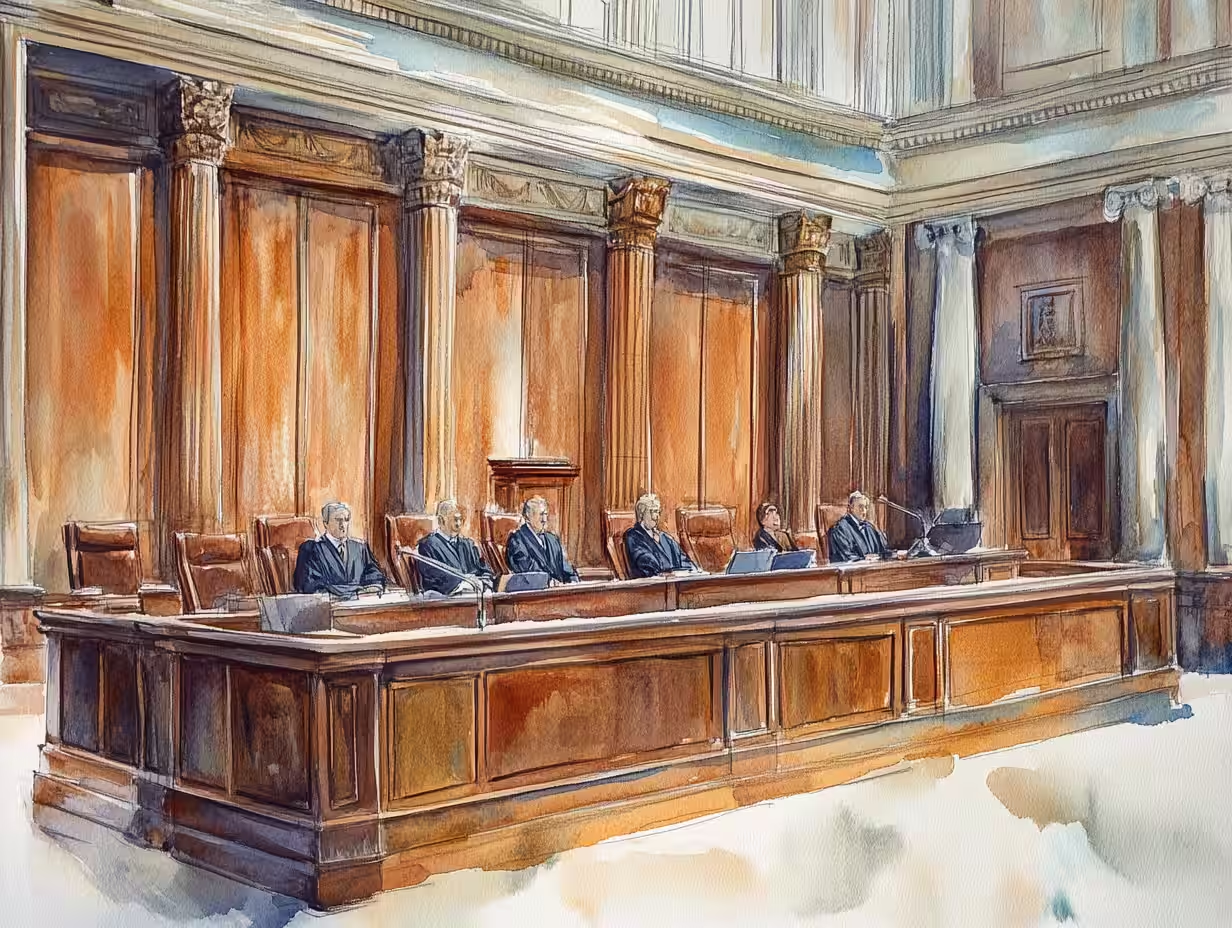
The Utah Appellate Court
The Appellate Process: A Step-by-Step Guide
Most Utah appeals are decided by the Utah Court of Appeals, a seven-judge intermediate appellate court that handles the majority of civil and criminal appeals from the district courts. The significant exceptions — capital cases, first-degree felony convictions, and certain matters of statewide significance — go directly to the Utah Supreme Court, which also has discretionary certiorari jurisdiction over Court of Appeals decisions.
Both courts are located in Salt Lake City. They do not hold new trials, hear new testimony, or reconsider the facts. They review the legal questions the trial court decided and correct legal errors that affected the outcome. Lotus Appellate Law represents clients before both courts, as well as the California Court of Appeal.
For a complete picture of what appellate attorneys do and how appellate practice differs from trial work, see What Does an Appellate Attorney Do?
Step 1: Filing the Notice of Appeal
Everything begins with the notice of appeal. Under URAP Rule 4, the notice must be filed with the clerk of the district court that entered the judgment — not the appellate court — within 30 days after entry of the judgment or order being appealed.
This deadline is jurisdictional. Missing it by a single day — for any reason, including attorney error or excusable neglect — permanently destroys appellate jurisdiction. There is no good-cause exception for most civil matters. If you are approaching the deadline, contact Lotus Appellate Law immediately.
A few important nuances:
What triggers the 30-day clock. The clock runs from the date the judgment or order is entered in the district court docket — not the date it was signed, not the date it was served on the parties. Understanding exactly when the clock started is the first question in any appeal evaluation.
Shorter deadlines in specific situations. Two express carve-outs sit inside Rule 4 itself. Under Rule 4(a)(1), a notice of appeal in a forcible entry or unlawful detainer matter is due within 10 days of entry. Under Rule 4(a)(2), a notice of appeal from an order denying a motion to dismiss under Utah’s Public Expression Protection Act is due within 21 days — not 30. Separately, a non-final ruling is not appealed by notice at all: it requires a petition for permission to appeal under URAP Rule 5, filed within 21 days of the challenged order. Each of these runs faster than the deadline most litigants assume applies.
Tolling by post-trial motions. Certain post-trial motions — including motions for new trial, motions to alter or amend judgment, and certain fee motions — toll the 30-day appeal deadline under URAP Rule 4(b). The motion must itself be timely filed to produce the tolling effect.
Post-judgment rulings require an amended notice. When the district court enters additional rulings after the original notice of appeal — attorney fee awards, costs orders, rulings on post-trial motions — those rulings are not automatically included in the appeal. Each requires an amended notice of appeal filed within 30 days of the new ruling. Missing the amended notice permanently forfeits appellate review of those rulings. See Amending a Notice of Appeal in Utah and Exceptions to the Final Judgment Rule in Utah for the full framework.
For the complete interactive reference of every filing deadline in the Utah Rules of Appellate Procedure, see Lotus Appellate Law‘s URAP Filing Deadlines reference.

Step 2: Preparing the Record on Appeal
After the notice of appeal is filed, the appellant must designate the record — identifying which transcripts and documents from the district court proceedings will be transmitted to the appellate court. Under URAP Rule 9, the docketing statement (filed within 21 days of the notice of appeal) includes a transcript designation section.
The appellate court reviews only what is in the record. Evidence not transcribed, arguments not on the record, and rulings not captured in the transcript do not exist for appellate purposes. The appellant bears the burden of providing a sufficient record — when the record is inadequate through the appellant’s failure to designate necessary portions, the appellate court may assume the missing proceedings support the trial court’s ruling and affirm.
Transcript ordering is among the most consequential early decisions in any appeal. A useful starting point: any hearing that ran eight minutes or longer likely contains something worth reviewing. But the more reliable approach is to confer with trial counsel about which hearings contained substantive argument or oral rulings, and then — critically — to also speak separately with the client. If trial counsel believes a hearing is unnecessary but the client believes it is important, defer to the client. It is their life or livelihood on the line, and the cost of an unnecessary transcript is always lower than the cost of a procedural default.
See The Record on Appeal in Utah Criminal Cases and Transcript Requests in Utah Appeals for the full framework on building the right record from the start.

Step 3: Drafting the Opening Brief
The brief is where the appeal is actually argued. Under URAP Rule 24, the opening brief must contain a statement of the issues, a statement of the case and facts with record citations, and the argument — each issue argued with citation to the record and legal authority. The opening brief is due 40 days after the record is filed with the appellate court, though extensions are routinely granted.
The word limit is 14,000 words — 1,000 more than the United States Supreme Court allows. That is room for three to four well-developed issues. More is not better in appellate practice. Appellate courts respond to focused, well-developed arguments, not comprehensive lists of every grievance from trial. Issue selection is one of the most consequential strategic decisions in every case Lotus Appellate Law handles.
Every brief must include a preservation citation. For every issue argued, the brief must identify where in the record the issue was raised in the trial court — or explain the grounds for plain error or exceptional circumstances review. An issue without a preservation citation is an issue the court will likely disregard.
The standard of review must be addressed for every issue. The standard of review is the lens through which the appellate court evaluates each argument. De novo — pure legal questions — gives the appellant full independent review with no deference to the trial court. Abuse of discretion is deferential. Clear error is very deferential. The correct standard of review must be identified and argued for each issue, because it determines both the framing of the argument and the likelihood of success.
The rule governs everything. The governing legal standard — the statute, rule, or case-made test the court will apply — should organize the argument, the headings, and the statement of facts. A brief organized around what happened at trial is less persuasive than a brief organized around what the law required and where the trial court departed from it. See The Rule Is King and What Does the Rule Say? for the brief-writing principles Lotus Appellate Law brings to every opening brief.
Every independent basis for the trial court’s ruling must be challenged. If the trial court gave three reasons for its ruling and the appellant successfully undermines only two, the third reason — left standing — is sufficient to affirm. This is one of the most commonly forfeited appellate arguments — addressed in detail at Attack Each Independent Ground on Appeal.

Step 4: The Appellee’s Brief and the Reply
Once the appellant has submitted their brief, the opposing party–called the appellee–has 30 days to respond with an answering brief. The appellee’s brief addresses the appellant’s arguments, defends the trial court’s ruling, and may identify alternative grounds for affirmance that the trial court did not reach.
The appellant may then file a reply brief within 21 days of the answering brief. The reply brief is shorter than the opening brief and responds directly to the appellee’s arguments — it does not raise new issues or re-argue the opening brief at length.
If the appellee has filed a cross-appeal — challenging some aspect of the ruling that was unfavorable to them — the briefing schedule adjusts to accommodate the additional arguments. A notice of cross-appeal must be filed within 14 days of the appellant filing the original notice of appeal.
Step 5: Oral Argument
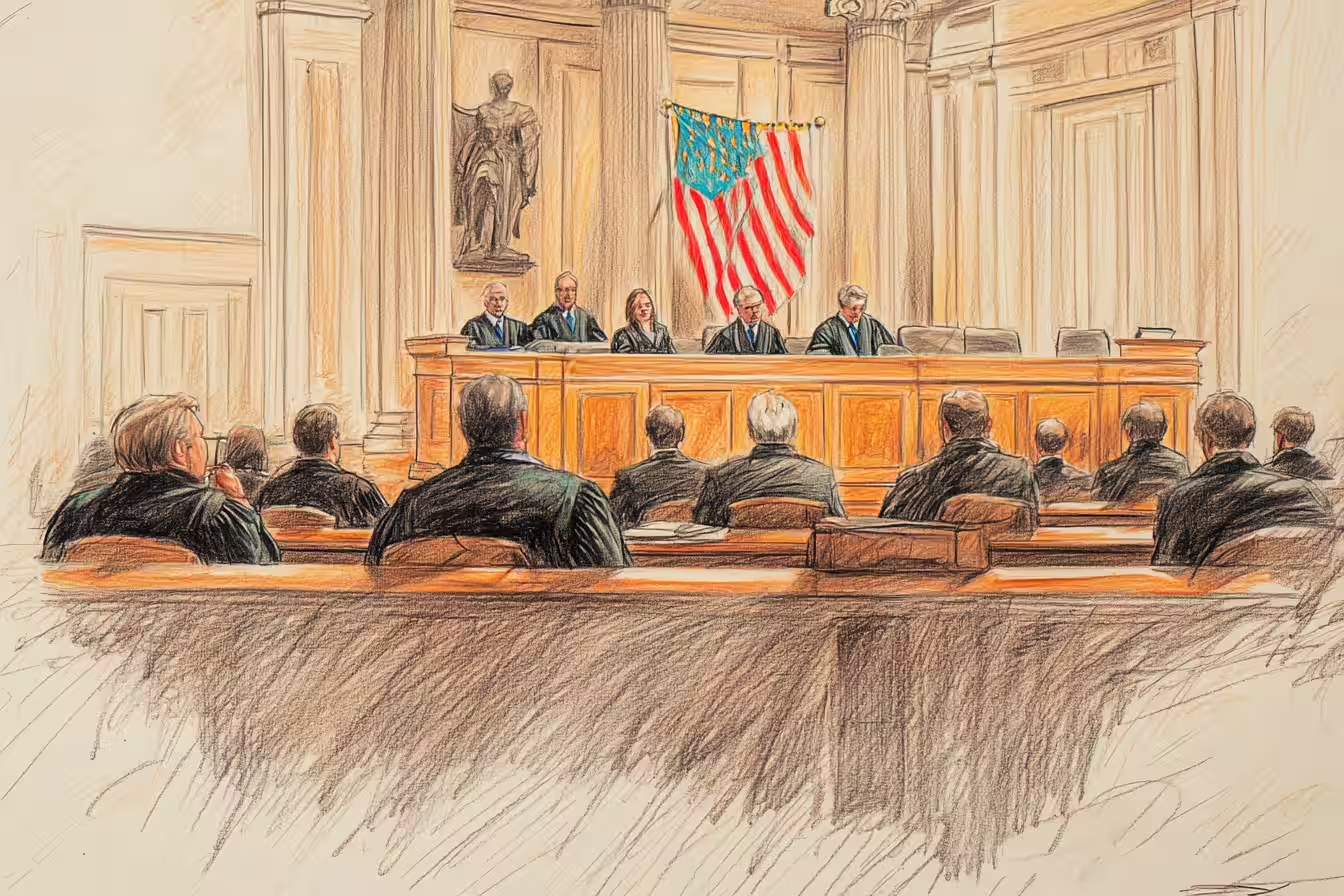
After briefing is complete, the appellate court decides whether to schedule oral argument. In the Utah Court of Appeals, argument is not held in every case — the court determines whether argument will materially assist in resolving the issues presented and issues a scheduling order only in cases where it believes argument would help. In the Utah Supreme Court, argument is held in every case the court agrees to hear.
When argument is scheduled, each side receives 15 minutes at the Utah Court of Appeals and 20 minutes at the Utah Supreme Court. Oral argument is not a presentation — it is a dialogue. The judges have already read the briefs. They have formed questions. The attorney who walks in expecting to deliver prepared remarks and walks out without having answered a probing question about the weakest point in the brief has not had an effective argument.
Effective oral argument requires command of the entire record, the entire body of relevant law, and the ability to address questions the brief did not anticipate — including questions about the implications of the rule being advanced for future cases beyond this one. It requires knowing the case well enough to concede what must be conceded and hold ground where the law supports it.
Preparation for oral argument is intensive, calendar-clearing work. Lotus Appellate Law treats every oral argument as its own distinct preparation project, separate from and beyond the briefing work that precedes it.
For an honest account of what appellate representation costs and why, see Why Is Filing an Appeal So Expensive?

Step 6: The Decision
After oral argument — or after briefing concludes in cases where argument is not held — the panel of judges confers, assigns the writing, and issues a written decision. The decision may take the form of a published opinion (which has precedential effect), a memorandum decision (not precedential), or a per curiam order.
The possible outcomes:
Affirmed. The trial court’s ruling stands. The appellate court found no reversible error — either no legal error occurred, or any error that occurred was harmless.
Reversed. The trial court’s ruling is overturned. Outright reversal without remand is relatively uncommon and is typically reserved for situations where only one outcome is legally permissible.
Vacated and remanded. The most common outcome when an appeal succeeds. The ruling is set aside and the case returns to the district court for further proceedings — a new trial, a new sentencing hearing, a recalculation of damages, or reconsideration under the correct legal standard. Remand is not a guaranteed different result — it is a guaranteed legally correct process the second time around.
Affirmed in part, reversed in part. Some issues succeed and others do not. The case may be remanded on specific issues while the remainder of the judgment stands.
The timeline from notice of appeal to final decision is typically 12 to 24 months at the Utah Court of Appeals. Utah Supreme Court proceedings, particularly after certiorari is granted, often run longer.
For a full treatment of what each type of reversal actually produces — and why winning on appeal rarely ends the case — see What Is the Remedy on Appeal in Utah?
Key Considerations in Every Utah Appeal
Standard of Review
The standard of review is the single most important concept in appeal strategy. It defines how much deference the appellate court gives to the trial court’s ruling — and how strong the case for reversal needs to be on any given issue.
Correctness (de novo) applies to pure legal questions — statutory interpretation, constitutional issues, jury instruction accuracy. The appellate court decides the question independently with no deference to the trial court. This is the most favorable standard for appellants.
Abuse of discretion applies to most evidentiary rulings, sentencing decisions, and procedural calls. The court reverses only if the trial court exceeded the permissible range of choices the law allows.
Clear error applies to factual findings made by the trial court or a jury. The court reverses only if the finding is against the clear weight of the evidence — the most deferential standard.
One important nuance: even a ruling that appears discretionary may contain an embedded legal error that is reviewed for correctness. When a legal conclusion is embedded in a district court’s discretionary determination, Utah appellate courts peel back the deferential standard and review the legal question de novo. A court does not have discretion to misapply the law — and when it does, that legal error is reviewed without deference regardless of how the overall ruling is characterized. See Correctness or Abuse of Discretion? for the full Boyden framework and its briefing implications.
Preserving Issues for Appeal
The most important concept in appealing a case is one that is decided entirely at the trial court level: issue preservation. Utah’s preservation doctrine — established in State v. Holgate, 2000 UT 74 — requires that claims not raised before the trial court may not be raised on appeal.
Preservation requires a specific, timely objection on the correct legal ground, followed by a ruling from the trial court. A general objection does not preserve a specific legal argument. An objection on one ground does not preserve a different ground. An argument raised for the first time in the appellate brief — without a citation showing it was raised below — will be rejected.
The narrow safety valve is plain error review — available when an unpreserved error was so obvious that the trial court should have corrected it without being asked, and so harmful that a different outcome was reasonably probable. Most plain error arguments fail. The unpreserved issue that loses on plain error would very likely have succeeded on preserved de novo review.
The preservation decision is made during the trial — not after the verdict. That is the foundational argument for embedded appellate counsel: preserving appeal options requires appellate expertise at the trial stage. For the full preservation framework, see Issue Preservation in Utah Criminal Appeals — the same doctrine applies in all civil appeals.
Timing and Deadlines
Every stage of a Utah appeal has a strict deadline. Missing any of them can permanently foreclose rights that cannot be recovered. The most critical:
|
Deadline |
Rule |
Time |
|---|---|---|
|
Notice of appeal |
URAP 4 |
30 days from entry of judgment |
|
Interlocutory petition |
URAP 5 |
21 days from entry of order |
|
Docketing statement |
URAP 9 |
21 days from notice of appeal |
|
Opening brief |
URAP 26 |
40 days after record filed |
|
Answering brief |
URAP 26 |
30 days after opening brief |
|
Reply brief |
URAP 26 |
21 days after answering brief |
|
Post-trial motion (tolls appeal clock) |
URCP 59 |
28 days from entry of judgment |
|
Notice of cross-appeal |
URAP 4 |
14 days after original notice |
|
Petition for certiorari |
URAP 48 |
30 days after Court of Appeals decision |
For the complete interactive deadline reference, see Lotus Appellate Law‘s URAP Filing Deadlines reference.
Moreover, understanding the timeline for the appellate court’s decision is vital for both parties. While some cases may be resolved quickly, others can take months or even years, depending on the complexity of the issues and the court’s workload. This uncertainty can affect various aspects, including strategy, potential settlements, and the overall emotional and financial toll on the parties involved.
Possible Outcomes of an Appeal
A successful appeal most commonly results in remand — the case returns to the district court for correction of the legal error. Remand is not a guaranteed different result. It is a directive to the trial court about what went wrong and how it must be addressed on the return. The same judge typically presides after remand.
Outright reversal without further proceedings is reserved for situations where only one legal outcome is permissible — most commonly, a sufficiency of the evidence challenge that produces acquittal, or a civil ruling so clearly wrong as a matter of law that no further proceedings are necessary.
Resentencing results when the appeal succeeds only on sentencing issues — the conviction stands but the sentence is vacated and a new sentencing hearing follows.
An appeal that succeeds produces a right to a correct process — not a guarantee of a different substantive outcome. Understanding what winning actually looks like, for each issue being pursued, is one of the most important conversations Lotus Appellate Law has with every client before committing to an appeal.


Conclusion
The appeal process is a complex but essential aspect of the justice system in Utah. It serves as a vital check on the decisions made by lower courts, ensuring that justice is served and legal standards are upheld. By understanding the procedural steps involved, from filing a Notice of Appeal to presenting oral arguments, litigants can better navigate the appeals process and protect their legal rights.
While the appeal process can seem daunting, familiarity with its stages, key considerations, and potential outcomes can empower parties to make informed decisions regarding their cases. Whether you are an attorney representing a client or an individual seeking to appeal a ruling, being well-prepared and aware of the nuances of the appellate system will enhance your chances of achieving a favorable outcome.

Let us help you
Given these complexities, it’s crucial to consult with an experienced appellate attorney early in the process to evaluate whether your case is a good candidate for appeal. At Lotus Appellate Law, we thoroughly review the appellate record, identify all available issues, and which issues have the greatest likelihood of success, ensuring you have a realistic understanding of your options.
Lotus Appellate Law — Contact us for a case evaluation
Meaningful appellate representation goes beyond filing a brief. It begins with understanding the trial record, identifying every issue worth pursuing, and knowing how Utah’s appellate courts actually decide cases. Lotus Appellate Law works with Utah litigants and trial counsel at the trial stage, on direct appeal, and through post-conviction proceedings — at the Utah Court of Appeals, the Utah Supreme Court, and beyond.
The next step is a conversation — schedule a call with Lotus Appellate Law.
Frequently Asked Questions
Utah Appellate Process