Utah Supreme Court Petitions: Certiorari, Rehearing, and Original Jurisdiction

Losing at the Utah Court of Appeals is not always the end of the case. The Utah Supreme Court reverses at nearly 1.5 times the rate of the Court of Appeals — but review is discretionary, narrow, and governed by some of the most exacting procedural rules in Utah practice.

Justice may still be within reach — Contact Lotus Appellate Law to discuss your appeal.

Why Supreme Court Practice Is a Different Discipline

A petition to the Utah Supreme Court is not a second appeal. It is not a chance to relitigate whether the Court of Appeals reached the right result. Under URAP Rule 46, the Supreme Court grants certiorari “only for special and important reasons,” and the rule says so explicitly: “the possibility of an error in the Court of Appeals’ decision, without more, ordinarily will not justify review.” The primary consideration is whether the question presented is likely to have significant precedential value — not whether the petitioner has a sympathetic case.

That single sentence reframes everything about how a Utah Supreme Court petition must be written, argued, and evaluated. This guide, prepared by Utah appellate attorneys at Lotus Appellate Law, covers the full landscape of Utah Supreme Court practice: certiorari review, petitions for rehearing, the Court’s original and direct jurisdiction, the unique transfer-and-retention system between Utah’s two appellate courts, amicus practice, extraordinary writs, and what happens once review is actually granted.

two businesspeople discussing documents in warm window light watercolor mood

What Is a Writ of Certiorari?

A writ of certiorari is the mechanism by which the Utah Supreme Court reviews a decision of the Utah Court of Appeals. Unlike an appeal as of right from a district court to the Court of Appeals, certiorari review is entirely discretionary. The Supreme Court chooses which cases to hear, and it chooses based on the importance of the legal question presented — not simply because the Court of Appeals may have gotten something wrong.

See our full explainer: What Is a Writ of Certiorari? Utah Supreme Court Review Explained.

soft lit watercolor portrait of thoughtful woman on paper background

The Standard for Granting Review

URAP Rule 46(a) identifies the considerations that typically drive a grant: a question regarding the interpretation of a constitutional provision, statute, or rule likely to affect future cases; a legal question of first impression likely to recur; an opportunity to resolve confusion or inconsistency in a legal standard; or a decision that conflicts with prior Utah Supreme Court or Court of Appeals precedent. Lotus’s own analysis of nearly 30 years of Utah appellate opinions shows the Supreme Court reverses at 46.2% — markedly higher than the Court of Appeals’ 30.3% — a direct consequence of the Court granting review primarily where genuine legal uncertainty exists.

See The Standard for Granting Certiorari in Utah.
somber man addressing courtroom under warm dramatic light watercolor

Drafting the Petition

A petition for writ of certiorari must comply with URAP Rule 49 — including a recently reduced 15-page limit, a new word-count requirement, and a mandatory certificate of compliance. The petition is the entire argument; no separate brief in support is permitted.

See How to Draft a Winning Petition for Writ of Certiorari in Utah.

two people talking in warm windowlight moody watercolor illustration

The Deadlines That Govern Everything

A petition must be filed within 30 days after the Court of Appeals’ final decision — not the remittitur date — under URAP Rule 48. A timely petition for rehearing under Rule 35 tolls this deadline. Extensions are available but capped and require a specific showing.

See The 30-Day Clock: Certiorari Deadlines and How Rehearing Petitions Affect Them.

Rehearing vs. Certiorari

These two mechanisms are frequently confused, and the confusion costs litigants their rights. A petition for rehearing under URAP Rule 35 asks the same court to reconsider a point it “overlooked or misapprehended.” A petition for certiorari asks a different, higher court to take the case for reasons of legal importance.

See Petition for Rehearing vs. Petition for Certiorari: Two Different Tools.

two businessmen reviewing documents in sunlit office warm focused mood

Responding to a Petition

The party who won at the Court of Appeals does not have to respond to every certiorari petition filed against them — and strategically, sometimes should not. Under URAP Rule 50, a brief in opposition is capped at 15 pages, and the Court may issue a “call for response” if it wants one even after a waiver.

See Responding to a Certiorari Petition: The Brief in Opposition Strategy.

Original and Direct Jurisdiction

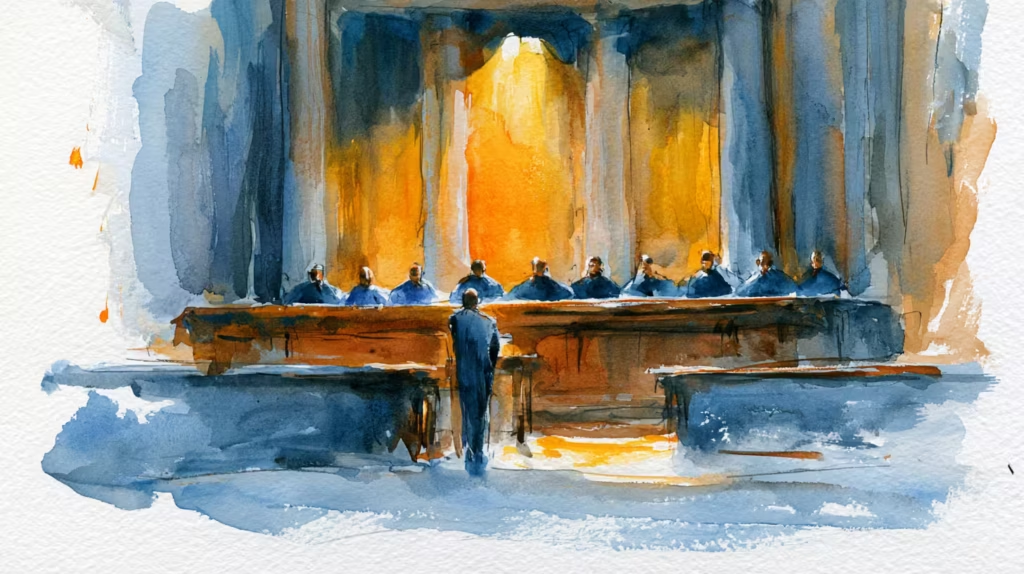
Some cases never pass through the Court of Appeals at all. Under Utah Code § 78A-3-102, the Supreme Court has original appellate jurisdiction over capital and first-degree felony convictions, facial constitutional challenges to statutes, certain administrative agency reviews, and election and legislative-subpoena matters.

See Original and Direct Jurisdiction: When Your Case Skips the Court of Appeals Entirely.
sole figure addressing judges in glowing courtroom watercolor mood

The Transfer-and-Retention System

Summary judgment rulings are reviewed by the Utah Court of Appeals and UtUtah uses a “pour-over” docketing system: most appeals are technically filed with the Supreme Court first, which then transfers the bulk of them to the Court of Appeals under URAP Rule 42. Parties can request retention. The Court of Appeals can also certify a case up to the Supreme Court under URAP Rule 43.

See The Utah Supreme Court’s “Pour-Over” System: Transfer, Retention, and Certification.

somber watercolor portrait of elderly man in soft lighting

Amicus Practice at the Certiorari Stage

Amicus curiae briefs can signal to the Court that a case has significance beyond the parties — directly relevant to the “precedential value” standard that drives certiorari grants. URAP Rule 25 governs timing and consent requirements, which differ at the cert stage from merits-stage practice.

See Amicus Curiae Practice at the Utah Supreme Court Certiorari Stage.

Extraordinary Relief

Separate from certiorari and direct appeal, the Supreme Court (and Court of Appeals) can issue extraordinary writs — mandamus, prohibition, and habeas corpus — under URAP Rule 19, available only when “no other plain, speedy, or adequate remedy” exists.

See Extraordinary Relief at the Utah Supreme Court: Mandamus, Prohibition, and Habeas Corpus.

After Certiorari Is Granted

Granting review is the beginning, not the end. Merits briefing, oral argument (20 minutes per side, versus 15 at the Court of Appeals), and the eventual remittitur all follow a distinct procedural track.

See What Happens After Certiorari Is Granted: Merits Briefing at the Utah Supreme Court.

solitary man reading in sunlit cathedral watercolor serene mood

Work With Lotus Appellate Law

A Utah Supreme Court petition demands a different kind of advocacy than a Court of Appeals brief — the question is not whether the lower court erred, but whether the legal issue matters enough for the state’s highest court to weigh in.

Lotus Appellate Law is a boutique Utah appellate firm built for exactly this work: identifying the precedential hook in a case, drafting petitions that meet the Rule 46 standard, and advocating before the Utah Supreme Court at every stage from certiorari through merits review.

If you have lost at the Utah Court of Appeals and believe your case presents the kind of legal question the Supreme Court should resolve, contact Lotus Appellate Law to discuss your options.

SCOUT Deadlines Reference

Action

Rule

Deadline

Petition for writ of certiorari

URAP 48

30 days from Court of Appeals’ final decision

Petition for rehearing

URAP 35

14 days from decision; tolls certiorari deadline

Extension of certiorari deadline

URAP 48

Up to 30 days, by motion before deadline expires

Cross-petition

URAP 48(d)

Within original deadline OR 30 days after original petition filed

Brief in opposition

URAP 50

Per court order; capped at 15 pages

Reply brief

URAP 50

1,500-word limit

Amicus brief (cert stage)

URAP 25

14 days after petition is filed

Remittitur (no rehearing filed)

URAP 36

15 days after judgment

Remittitur (rehearing filed)

URAP 36

5 days after order disposing of rehearing

Additional Topics on Utah Supreme Court Petitions

Compare Us

Should you Hire an Appellate Law Firm?

Trial Attorneys
$$$$$
  • Broad understanding of district court rules
  • Limited understanding of appellate process
  • Oral advocacy style well suited to juries
  • Familiar with district court clerks
  • Unfamiliar with parts of appellate brief
  • May not have appellate clerkship
  • Reputation with district court judges, not appellate judges
  • Less efficient use of billable hours on appeal
  • A history of success in trial courts
  • Up-to-date trial court training
a logo with a black background
$$$
  • Experts in appellate court rules
  • Deep understanding of appellate process
  • Oral advocacy style well suited to judges
  • Familiar with appellate court clerks
  • Persuasive brief writing
  • Attorneys have appellate clerkships
  • Great reputation with appellate judges
  • Efficient use of billable hours
  • A history of success in appellate courts
  • Up-to-date appellate court training

Frequently Asked Questions

Utah Appellate Process

An appeal is a formal request to a higher court to review a lower court’s decision for legal error. It is not a new trial — no new witnesses testify and no new evidence is introduced. The Utah Court of Appeals and Utah Supreme Court review the written record and the parties’ legal briefs to determine whether the trial court correctly applied the law. In family law cases, that includes whether the court properly applied standards governing custody, property division, and alimony under Utah’s statutory framework.

Most final judgments entered by a Utah district court can be appealed, including civil, criminal, and administrative matters. Not every ruling is immediately appealable — generally, the order must be a final judgment that fully resolves the case, unless an interlocutory appeal under URAP Rule 5 is available. Lotus Appellate Law handles appeals across a wide range of civil and criminal practice areas before the Utah Court of Appeals and Utah Supreme Court.

Whether your case has viable appellate issues depends on two things: whether a legal error occurred, and whether that error was preserved in the trial court record. The Utah Court of Appeals gives significant deference to trial court fact-finding, so appeals grounded purely in disagreement with the outcome rarely succeed. Appeals grounded in misapplication of law, failure to make required findings, or abuse of discretion have a legitimate path forward. Lotus Appellate Law offers case evaluations to help you make that determination honestly.

The appeal begins with filing a Notice of Appeal in the district court that entered the judgment. That notice must be filed within 30 days of the entry of the order or judgment being appealed — this deadline is jurisdictional and cannot be extended for most civil matters. After filing, the appellant designates the record on appeal, orders transcripts, and begins the briefing process under the Utah Rules of Appellate Procedure.

This window can be shorter in certain circumstances. For example, for interlocutory review of a non-final decision, the appealing party must file a notice within 21 days. And under UPEPA, the appealing party must file a notice of appeal within 15 days.

If the notice of appeal is not filed within 30 days of the entry of judgment, the Utah Court of Appeals loses jurisdiction over the case — regardless of how strong the underlying legal arguments are. There is no good-cause exception for most civil appeals. In limited circumstances, a motion to reinstate the appeal may be available if the failure to file was caused by excusable neglect, but this remedy is narrow and unreliable. If you are approaching the deadline, contact Lotus Appellate Law immediately.

Yes — a trial attorney can file the Notice of Appeal to preserve the deadline. However, appellate practice is a specialized discipline with different rules, standards, and briefing conventions than trial court work. Many clients retain dedicated appellate counsel at Lotus Appellate Law after the notice is filed to handle the briefing and, if granted, oral argument. Transitioning to appellate counsel early gives us maximum time to analyze the record and develop the strongest appellate arguments.

An appeal generally takes about two years, from start to finish. There are some outliers that may take more time or less time, but the entire process is usually around two years.

Only after you file your notice of appeal will you begin the rest of the process. That process includes ordering transcripts of the proceedings, compiling a copy of the record, getting the briefing schedule from the appellate court, and having an appellate attorney review the record. After you have discussed any appealable issues with your appellate attorney, your attorney will draft and file your Appellant’s Opening Brief, and a briefing exchange ensues. If you are appellee in this process, you will only respond to the opening brief with an Appellee’s Responsive Brief. If you are appellant, you will file both an opening brief and an Appellant’s Reply Brief.

After briefing is completed, your case could be called for oral augment. An appellate court does not hear oral argument in every case; sometimes it issues a written order or opinion without argument. You may ask your attorney to request oral argument, but that request is not always granted. In the months after argument or after briefing, your case will be decided by a panel of judges who will then begin to draft the opinion. Once the opinion has been reviewed and edited by all of the judges on the panel, it is reviewed and edited by the appellate court clerks, and then it is published and made available to the public.

Generally, no. On appeal, the trial or pre-trial record is the entire factual universe that the appellate court will consider. An appeal is not a “second bite at the apple.” You should never count on making arguments or presenting evidence on appeal that you failed to present to the trial court. In fact, appeals are regularly denied when a party relies on evidence outside the record.

The one exception to this rule is found in criminal cases and is available in accordance with Rule 23B of the Utah Rules of Appellate Procedure. Under this rule, criminal defendants may try to admit evidence that their trial counsel provided unconstitutionally ineffective assistance at their trial. Under rule 23B, a motion is filed concurrently with the Appellant’s Opening Brief. That motion has attached to it any missing evidence that the trial court should have considered, along with affidavits attesting the evidence’s accuracy. If a prima facie showing of ineffective assistance of counsel is made in this motion, then the appellate court will remand the case back to the district court to admit the missing evidence. The missing evidence is admitted during an evidentiary hearing. Oftentimes trial counsel has the opportunity to testify and explain his or her strategy, or lack of strategy. The case is then sent back to the court of appeals for a final determination of ineffective assistance.

The number of issues you raise is not limited by rule, but in Utah your attorney must file an opening brief with 14,000 words or fewer. That is 1,000 words more than the United States Supreme Court allows. That is room for about three to four well argued issues. For that reason, there is no hard rule limiting the number of issues, but more is not better in appellate practice. Appellate courts respond to focused, well-developed arguments — not comprehensive lists of every grievance from trial. A strong opening brief identifies the two to four issues most likely to result in reversal and develops each with thorough legal analysis and record citation. At Lotus Appellate Law, issue selection is one of the most consequential strategic decisions we make in every case.

A strong appellate issue in Utah typically has three characteristics: it was preserved in the trial court through objection, motion, or argument; it involves a legal error rather than a factual dispute the trial court resolved against you; and the standard of review gives the appellate court meaningful room to act. Issues reviewed de novo — pure legal questions — are generally stronger than discretionary calls reviewed for abuse of discretion, though abuse of discretion claims can succeed when the trial court’s decision falls outside the range the law permits.

The cost of a Utah appeal varies depending on case complexity, transcript length, and the number of issues briefed. Lotus Appellate Law provides honest cost assessments during the initial consultation so clients can make informed decisions before committing to an appeal.

Appellate courts in Utah have authority to award attorney fees on appeal when the underlying statute or agreement authorizes fee-shifting, or when the appeal was taken frivolously. Whether fees are recoverable in your specific case depends on the governing statute and the nature of the appeal — Lotus Appellate Law evaluates this as part of every case assessment.

A successful appeal most commonly results in a remand — the case is returned to the trial court with instructions to correct the legal error. Outright reversal is less common and typically reserved for clear legal error where only one outcome is legally permissible. A win on appeal does not guarantee a different substantive outcome — it guarantees that the trial court must get the law right the second time.

In most cases where the appeal results in remand, yes — further trial court proceedings follow. The scope depends on what the appellate court ordered. Some remands are narrow; others reopen broader issues. In cases of outright reversal with no remand, no further proceedings are required. Lotus Appellate Law prepares clients for what a successful appeal realistically means before they commit to pursuing one.

Depending on the circumstances, options may include a motion for new trial or motion to reconsider in the trial court, which can also toll the appellate deadline under certain conditions. In rare cases, an extraordinary writ may be available. Each remedy has different requirements and timelines. Lotus Appellate Law can help you understand which path — or combination of paths — makes sense for your situation.

Lotus Appellate Law is a Salt Lake City appellate firm representing clients throughout the state of Utah. Because appellate practice takes place before the Utah Court of Appeals and Utah Supreme Court — both located in Salt Lake City — we represent clients from every Utah county, including Salt Lake, Utah, Davis, Weber, Washington, Cache, Tooele, Summit, and Wasatch counties, as well as rural districts statewide.

Don’t Leave Your Appeal to Chance

Trust Lotus Appellate Law – Utah’s Leading Appellate Attorneys to Fight for Your Best Outcome